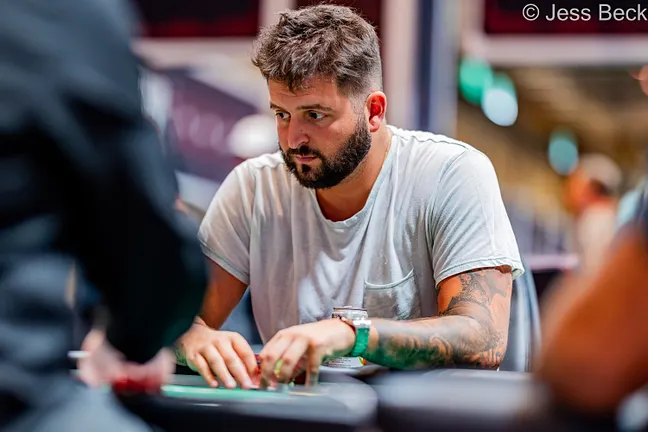
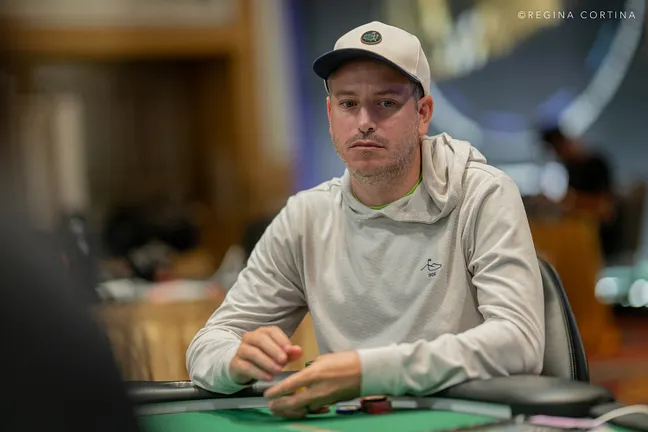
This hand was picked up with approximately 5,000 in the middle on a board that read 4♠3♣8♣K♦. Charles Davis and Christian Nikprelaj checked from the small and big blind, respectively. Jake Schwartz put out a wager of 2,500 from early position. This led to a fold from Davis and a call from Nikprelaj.
Nikprelaj slipped it over to Schwartz on the A♣ river. Schwartz did not bite as he checked back.
Nikprelaj showed that the river was a good one for him as he tabled 10♣2♣ for a flush to take the pot.
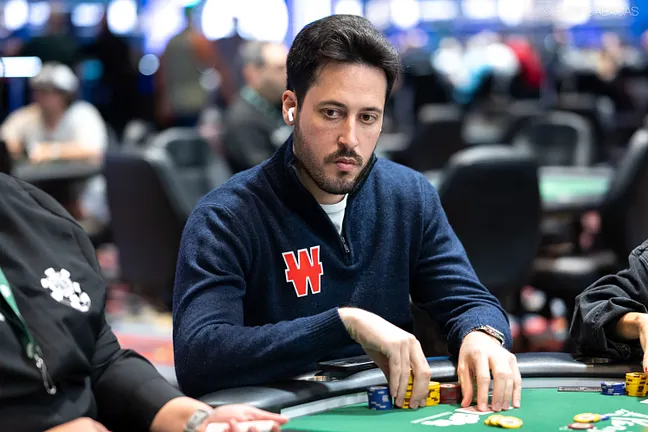
In one of the first hands of the day, Mathew Schiavo opened to 700 from middle position and Adrian Mateos three-bet to 2,500 from the cutoff. David Sayago four-bet to 6,600 from the small blind and only Mateos called.
The 7♠3♣4♠ flop saw Sayago bet 5,700 and Mateos called to see the 5♠ turn.
Both made slow checks to the 10♣ river and Sayago bet 6,200 and Mateos went into the tank. After around a minute, he called and Sayago tabled his A♠K♠ for the nut flush. Mateos quickly mucked and lost around a third of his stack.
Action was picked up on the turn of a hand with 6,000 in the pot.
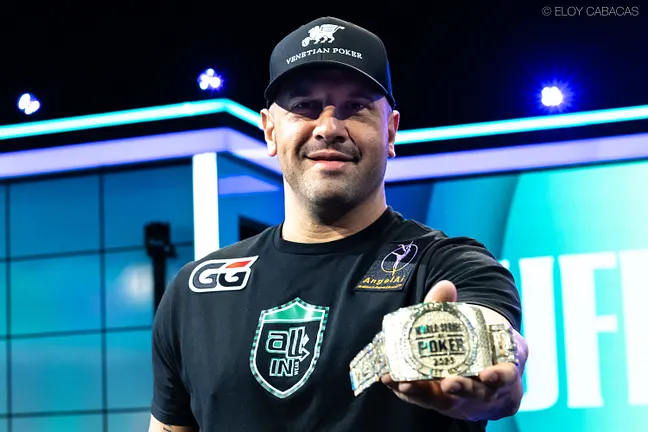
The board read 8♦8♣K♣J♠ and cutoff Peter Drees checked over to Masaji Nakamizo on the button. The latter bet out for 2,500, and Drees took some time before putting in the call.
The A♦ came on the river, and Nakamizo didn't slow down when checked to. He opted for 7,500 as his sizing, and Drees made the fold.
Shuffle Up & DealShuffle Up & DealShuffle Up & DealShuffle Up & DealShuffle Up & Deal
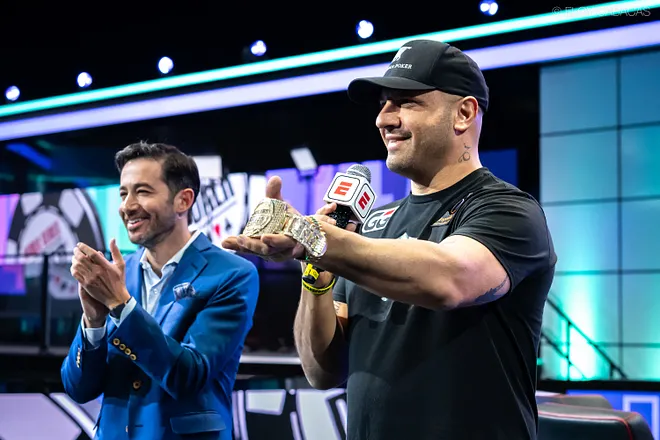
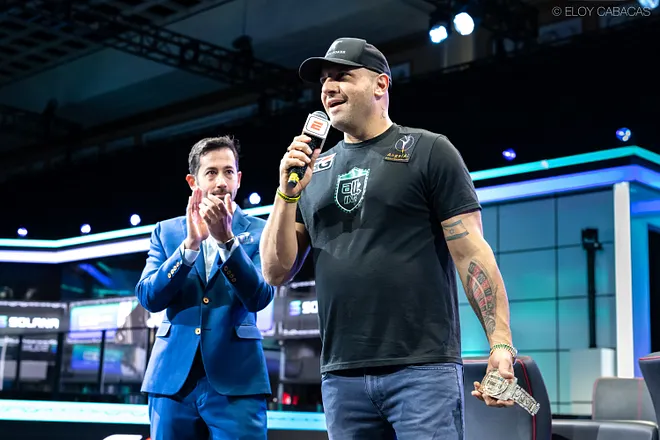
Following a few words from the reigning Main Event Champion, Michael Mizrachi, the cards are in the air for Day 1a of the Main Event with 457 already in their seats.
Kicking off July 2, 2026, with four starting flights, the prestigious event returns once more to the WSOP schedule, ready to crown poker's next world champion.
The $10,000 buy-in freezeout format is synonymous with this event, as is the chance of winning life-changing money and being immortalized among the poker greats.
Each Day 1 will kick off at 11 a.m. and will play five 120-minute levels. A 20-minute break is scheduled after each level, with a 60-minute dinner break after Level 3 (~5:40 p.m.).
Remaining players will return for their respective Day 2s, with late registration open for seven levels (2 levels into July 6 & 7). The fields will combine on July 8, with play continuing for five levels each day until a final table is reached.
2026 WSOP Main Event Schedule
Date
Time
Event
Thu, July 2, 2026
11 a.m.
$10,000 WSOP Main Event Day 1a
Fri, July 3, 2026
11 a.m.
$10,000 WSOP Main Event Day 1b
Sat, July 4, 2026
11 a.m.
$10,000 WSOP Main Event Day 1c
Sun, July 5, 2026
11 a.m.
$10,000 WSOP Main Event Day 1d
Mon, July 6, 2026
11 a.m.
$10,000 WSOP Main Event Day 2abc
Tue, July 7, 2026
11 a.m.
$10,000 WSOP Main Event Day 2d
Wed, July 8, 2026
11 a.m.
$10,000 WSOP Main Event Day 3
Thu, July 9, 2026
11 a.m.
$10,000 WSOP Main Event Day 4
Fri, July 10, 2026
11 a.m.
$10,000 WSOP Main Event Day 5
Sat, July 11, 2026
11 a.m.
$10,000 WSOP Main Event Day 6
Sun, July 12, 2026
11 a.m.
$10,000 WSOP Main Event Day 7
Mon, July 13, 2026
11 a.m.
$10,000 WSOP Main Event Day 8
TBD
$10,000 WSOP Main Event Final Table
World Series of Poker Main Event History
The World Series of Poker Main Event traces its roots back to 1970, when Johnny Moss was voted the winner by his peers in a small gathering at Binion’s Horseshoe in downtown Las Vegas. Moss went on to win two more titles, in 1971 and 1974, making him one of only two players to win poker’s world championship three times. The other is Stu Ungar, who famously triumphed in 1980, 1981, and 1997.
The Main Event has long been poker’s proving ground. In 1989, a 24-year-old Phil Hellmuth ended Johnny Chan’s bid for a third straight title, defeating him heads-up to win $755,000 and his first bracelet. That victory kickstarted a career that has since produced a record 17 WSOP bracelets and earned Hellmuth a spot among the game’s most iconic and polarizing figures.
Back then, the field had just 178 players. It hovered around 200 through the late '80s before gradually rising again in the 1990s. By 1998, when Scotty Nguyen took the title, the field had grown to 350. From 1992 through the early 2000s, participation climbed steadily every year.
Then came 2003. Chris Moneymaker, a Tennessee accountant who qualified online, beat 839 others and won $2.5 million. His story lit the fuse for the poker boom and made the game's showpiece event feel truly accessible to anyone.
The very next year, Greg Raymer rode that momentum and beat a field of 2,576 to win $5 million, marking the biggest year-over-year jump in Main Event history. Joe Hachem followed with a win in 2005 over a field that had more than doubled again. Since then, the Main Event has consistently drawn over 6,000 players each year, with the exception of the pandemic-impacted 2020 edition.
In 2024, Jonathan Tamayo added his name to the record books by outlasting the largest field in WSOP Main Event history.
Stay closer than ever to the action with MyPlayers. This brand new, free feature on PokerNews puts your favorite poker players front and center. Whether you're keeping tabs on legends like Daniel Negreanu or following a friend grinding their way through a Day 2, MyPlayers delivers real-time updates tailored just for you. No subscriptions, no paywalls - just the hands, chip counts, and bustouts that matter most.
It’s simple: log in, search for any player in our live coverage, hit the star, and they’ll be added to your personalized MyPlayers list. You’ll see their progress across all live-reported events, with chip counts and updates pinned right where you need them at the top.
From railbirds to backers, MyPlayers is the smarter way to stay connected to the game.

 button in Safari